
He was a love object at ninety-six pounds. Little Frankie Lymon on “The Ed Sullivan Show,” snapping his fingers, flashing his new adult teeth. That the thirteen-year-old boy soprano from Harlem already knew a thing or two about hustling—that street precocity did not surface in his act. Frankie Lymon and the Teenagers, the doo-wop group he fronted, were slicked-back conks, they were letterman sweaters, they were loafers, they were noncoital sweet talk. Which was a nonnegotiable, what with the Teenagers being pubescent Black and Latino kids from around the way. Their first single, a lament co-written by Lymon, reached No. 1 on the Billboard R. & B. chart in early 1956. Tell the schoolyard lovesick, Frankie, “Why Do Fools Fall in Love?” He felt he knew. Grown women whom he slept with sometimes posed in mixed company as Sister or Mother. At twenty-four, the soprano ability gone, his coffers emptied by heroin and scammers, Lymon, in his addict’s senescence, spoke to a reporter from Ebony magazine; a year later, he would be found dead on his grandmother’s bathroom floor. In the interview, Lymon thought aloud on the erratic character of teen stardom, that volatile advertisement of innocence always tipping into insolence, which had ruled the popular-music industry in the fifties: “I never was a child, although I was billed in every theater and auditorium where I appeared as a child star. I was a man when I was 11 years old, doing what most men do.”
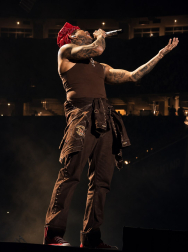
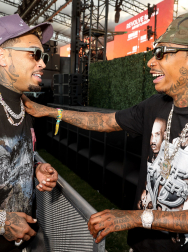
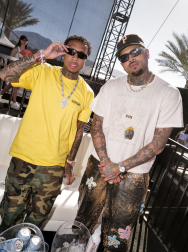
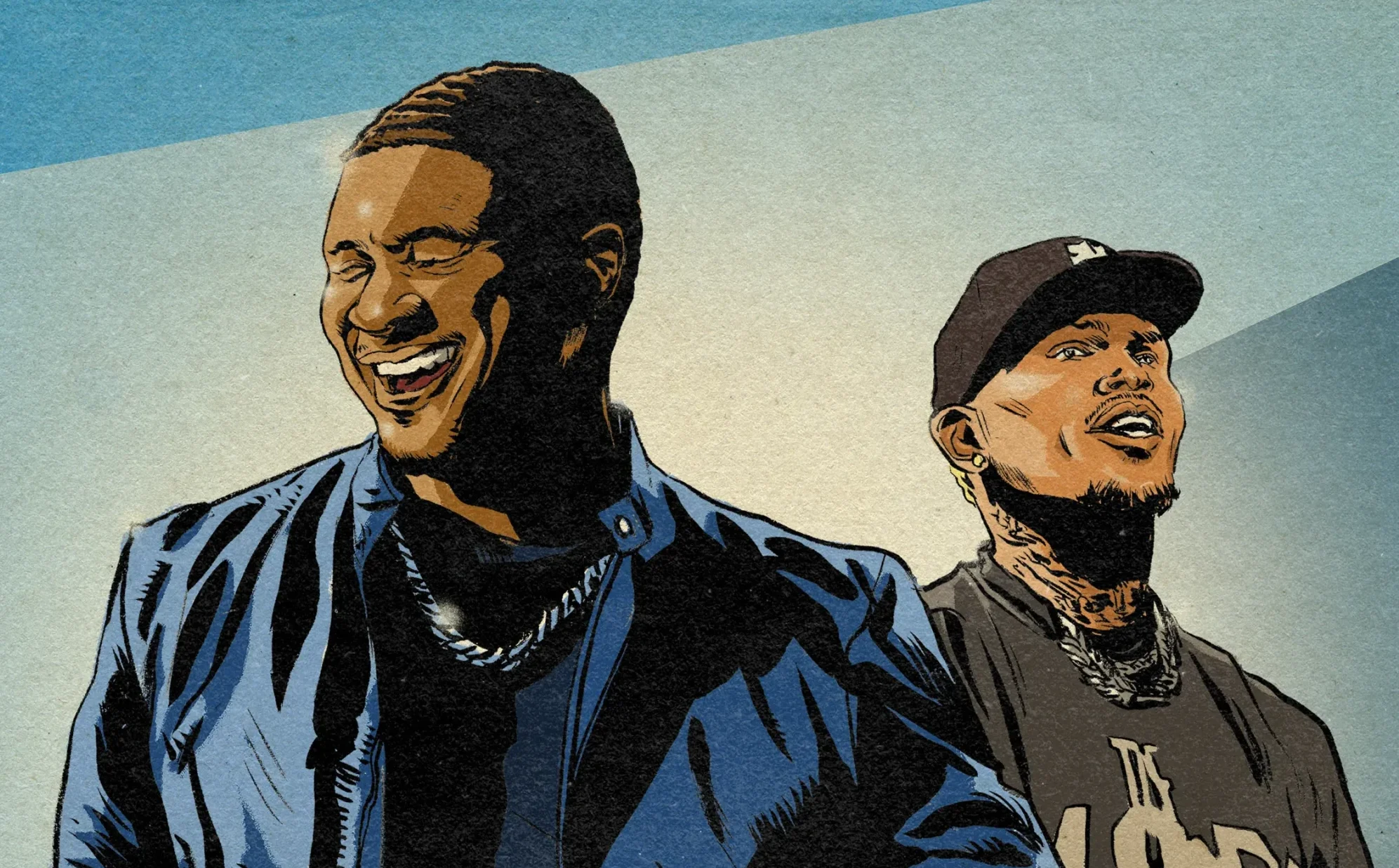
The two former teen idols I had gone to see perform at MetLife Stadium in early August—had they, as young, packaged, Black-boy love objects, been “doing what most men do?” You wonder about them, Usher and Chris Brown. Each man now appears, in his own way, timeworn. With Usher, who is forty-seven, it’s his inveterate agelessness, his pickling of his body in peak form, a kind of externalization of performer’s paranoia. With Brown, who is thirty-seven, it is in his hollowed-out jawline, and his body, too, fully tattooed or marked by his hard-knock adulthood. The pedigrees are not dissimilar. A parent notices the singing and dancing talent in the child, who is well churched. Phone calls and demos get made. There is scrounging to pay for flights to meet with executives in New York City and/or Atlanta. A season of mysterious grooming comes after, under the aegis of a Berry Gordy-like force, the period when the biological parents relinquish power and recede, so that in their absence the child star can be born. Usher, a protégé of L. A. Reid, débuted at fourteen, in 1993, with “Call Me a Mack”; Chris Brown, at fifteen, in 2005, with “Run It!” The two introductory salvos share a metaphor, that of dirty macking, or, in the context of post-Motown star-making, generational insurrection—the young-buck interloper sliding on the scene and declaring the girl, a.k.a. the audience, his to have, and her old man obsolete. The music is so sticky, and it is so good.
The shared project is called “The R&B Tour,” a play on words. One meaning refers to their surnames, Raymond and Brown. The other is a reference to the genre, presented as endangered and in need of saving. From what? We are in the second (some will argue third) decade of this debate, which is analogous to debates about the endangerment of rock music. Regarding R. & B., it is about the encroachment of rap, and then trap—particularly the lodestar element, the 808 kick—over a gauzy atmosphere of slow-burn groove. It is about the soul genre of the seventies being consequently feminized, made secondary to the businessman’s new-millennium art of hip-hop. It is about the disappearance of vocal stacking and pentatonic harmonies. It is about the embittering of the lexicon, the melismatic, pleading “baby” replaced with some variant of “my bitch.” It is about the queering of the crooner, the alienation from what is hetero and what is masculine. It is about the loss of pleasure-seeking. And many other perceived gripes.
That Friday, the sky had opened up. MetLife, an outdoor venue, was drenched, and the start was delayed. Guest Services gave out plastic ponchos. Workers had placed tarps on the stage, which was shaped like a massive arrow, to collect the storm. DJ Fresh, now acting as Brown’s hype man, did the warmup, vamping at his decks. Everyone whooped when he boomed into his mike that no one was scared of a little motherfucking rain. He did his casual-musicologist thing, plying the audience with crowd-pleasing summer songs like Cameo’s “Candy,” and slow jams like Tevin Campbell’s “Can We Talk.” A roving camera blasted people in the stands onto the jumbotron. Then Fresh, a conspiratorial look drifting across his face, announced that he was going to “try something.” R. Kelly’s “Bump n’ Grind” started up, and the people responded affirmatively. The lyric “I don’t see nothing wrong / with a little bump and grind,” representative of the acts of the man who had recorded it, currently in federal prison for racketeering and sex trafficking, was the maxim of the night: permissiveness, freedom in your body and whatever it decided it wanted to do.
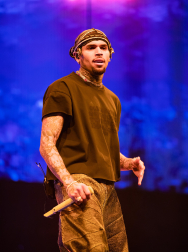
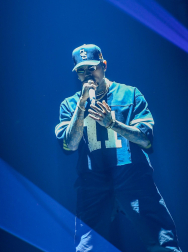
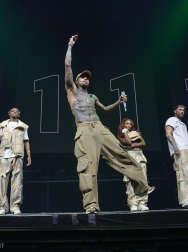
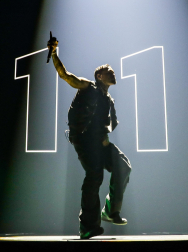
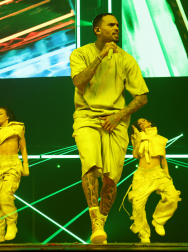
Was that audacity? Fresh knew the crowd he was playing to. To some, R. Kelly will always be Kellz, that savant figure, recipient of unending esteem, because of what he did for the culture, so to speak. This is who “The R&B Tour” is for. Around 9:30 P.M., the lights got low, a janky animation of the cosmos filled the screen, and our stars walked on—Usher shirtless with a floor-length fur coat, and Brown in a moto jacket. The approach of the former was to pause and bask; the latter, to launch with his backup dancers into a complicated set of steps. They seemed not at odds, but not connected, either, even when doing a give-and-take intro performance of their 2017 song “Party.” Why had they paired up? There was a tease, in October of last year, at the Atlanta stop of Brown’s solo “Breezy Bowl XX” tour, which grossed nearly three hundred million dollars: the two hugged onstage, and Brown called Usher his “brother.” (This was a necessary dispelling of the rumor that the two had got into a physical fight outside an Atlanta skating rink.) Their fraternity is in a manufactured inheritance narrative, each performer jockeying, after Michael Jackson, to be the King of R. & B.
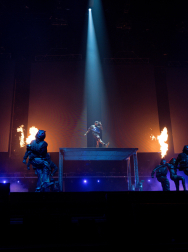
Early on in the show—a disjointed three-hour spectacle, featuring nearly sixty truncated songs, some ill-conceived A.I. interstitials, and one fire-breather—a video collage offers an (all-male) pantheon of the R. & B. greats. No Lymon, naturally, and no Bobby Brown, the pretty bad boy of the eighties and early nineties who bridged hip-hop and R. & B., and who seems the true predecessor to Chris Brown. Instead, a predictable picture of music dominance: Luther Vandross, Prince, Michael Jackson, Marvin Gaye in his crochet beanie. An animated Chris Brown downloads their juice, “transferring data” to his person. We are reminded that the teen-age Brown was pretty, too, selling Wrigley’s Doublemint gum in a TV spot; tipping his fedora, Mike Jack-style, to hip-switching girls on the block in a music video; doing Donny Hathaway mimicry in a Black family Christmas movie. The present-day Brown dances to “Yo (Excuse Me Miss),” one of those early, polite songs, as projections of his younger self fill the screen, and you can’t tell who is the shadow of whom. How he narrativizes his subsequent fall, following his arrest for assault and battery of this hemisphere’s then ascendant pop star, takes shape in a couple of so-called comeback albums, “Graffiti,” “F.A.M.E,” and “Fortune.” Written with collaborators such as Kevin McCall and Sevyn Streeter, the lyrics skew unrepentant fuckboy, the sound narcotic. “I’m chucking up my deuces to her.” “Look at me now, I’m getting paper.” “These hoes ain’t loyal,” and so on.
When Brown was a kid, he copied the choreography to Usher’s “My Way.” He was sold as a sort of Usher variant when he débuted; his singles, some of which were produced by the hitmaker Scott Storch, were further crunked-up versions of Usher’s discography. This is a tension in the tour. Usher does rule the roost, because his showmanship is so relaxed, honed, as it has been, by Vegas residencies. He was like a live Teddy Pendergrass then, maestro of the boudoir. It was his “My Way” residency, capped off with his 2024 Super Bowl performance, that launched his R. & B. reclamation project, as filtered through his diamond run of turn-of-the-millenium albums, “8701,” “Confessions,” and “Here I Stand.” At MetLife, Usher could not stop praising “8701,” which had just turned twenty-five years old, and which was, in a sense, a coming-out album: his openly idolatrous effort, guided by Jermaine Dupri, the Neptunes, and other visionaries, at imitating seventies soul men like Gaye. But Usher lost the thread with a subsequent tour, called “Past Present Future.” Fans wanted him to stay ossified; they weren’t into the halting experimentation of “Coming Home,” the album that he released in 2024. And so the current Usher is a legacy act, the lover who overstays his welcome.
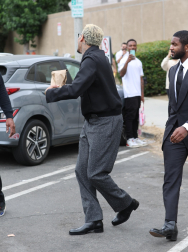
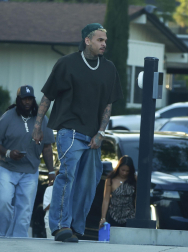
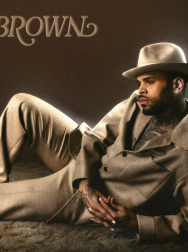
The writer Alphonse Pierre, in a recent pan of Brown’s latest album, the bloated wreck called “BROWN,” was right to call out critics for an attitude of righteous neglect toward the artist. He is Teflon, an intractable star, even as the charges—for assault, for domestic violence—mount against him. A good portion of the music world boosts Brown as its fragile prince, grafting a redemption narrative that flatters his princely persecution complex. Alicia Keys, H.E.R, and Mary J. Blige have guested on the tour; that night in Jersey, Tank, Fat Joe, Jadakiss, 50 Cent, and Eric Bellinger dropped in. A young woman standing behind me, wearing an “I <3 Chris Brown” crop top, got exasperated each time it was Usher’s turn to sing. She wasn’t here for him; he was “mad unc.” Brown’s female fandom is a pathologized one. Why do they defend him? His volatility is arousing, his bad-boy act steeped in diagnosed mental suffering. When he breaks down singing “I need to feel something,” in a song about sexual numbness, while looking physically and emotionally spent, you have to wince at the exposure. He hangs himself on wires and flies through the stadium for the women who love him. The stunt work comes toward the end of the show, the E.D.M. section, in which the performers seem the most venal, backloading the money-maker songs that threaten the very nostalgia that the tour is trying to exploit.
The Raymond and Brown show is all about sex, sex, sex. Usher sweeps through the crowd, his security looking exasperated, with a goblet of cherries, trawling for women. (This time, he had a husband feed his wife the fruit.) One night earlier in the tour, a woman Usher had brought onstage rebuked him, which embarrassed him. “I don’t think she wanna be on the stage,” he said. Pole dancers bookend him and are showered with Usher bucks, his prop cash. Brown, riffing on infamous stagecraft from Janet Jackson’s “Velvet Rope” tour, picks a gorgeous girl from the audience to be voluntarily handcuffed to a rig and then thrown on a bed, where he climbs on top of her. The crowd, drunk by the late evening, got handsy with each other when both singers came out singing, “Just let me rock, fuck you back to sleep.”
Lionel Richie, R. & B. elder statesman, we found out some days later, wasn’t on board with the project. “Usher and Chris Brown, see, they trying to do something new!” he told a crowd in Phoenix. He was on his own tour, with Earth, Wind & Fire. “We were doing that forty years ago. Only difference is, between then and now, we didn’t go to jail! We’re fine Christian men. Fine Christian men, that’s right.” Brown replied, on X, “Damn unk. We love you paw paw.”